Case Study
PayPal — Customers for Merchants: an integration love story
Product
PayPal Commerce Platform
Date
2020 – 2023
Role
Senior Product Designer
Categories
Fin-tech · B2B SaaS · Enterprise
01 Summary
At PayPal I was a Senior Product Designer on the Commerce Platform — building the unified Customers feature that spanned Braintree, Hyperwallet, and PayPal's core merchant dashboard. The feature became the foundation for vault-powered repeat commerce across PayPal's 35 million active merchants.
- End-to-end UX ownership: research, IA, interaction design, prototyping, design-system contribution, and engineering handoff
- Unified three separate customer data models (PayPal, Braintree, Hyperwallet) into a single coherent merchant-facing UI
- Designed the vault discovery experience that turned a developer-only capability into a merchant growth lever
- Conducted 40+ merchant interviews across SMB, mid-market, and enterprise tiers to shape the field taxonomy and progressive-disclosure model
02 Impact
03 The Problem
PayPal serves over 35 million active merchants — but they weren't using one PayPal. They were navigating three separate portals: PayPal for standard checkout, Braintree for developer-led payment processing and vault, and Hyperwallet for marketplace payouts. Each had its own login. Each had its own definition of what a "customer" was.
"The core design challenge: unify three separate portals, three separate logins, and three separate customer data models into a single coherent experience — without disrupting the 35 million merchants already relying on each product independently."
Standard checkout, invoicing, and P2P payments. Primary portal for SMBs and consumer-facing sellers.
✕ Isolated customer records
Developer-first payment gateway with vault tokenization. Portal for mid-market and enterprise merchants.
✕ Isolated customer records
Global payout infrastructure for marketplaces paying sellers at scale worldwide.
✕ Isolated customer records
04 The Vault
The vault was Braintree's crown jewel, but it was invisible to most merchants. Buried in API documentation, it was only used by developers who knew to look for it. My central design thesis: if we surface vault status prominently in the customer dashboard, merchants would understand its value and actively use it to drive repeat revenue.
merchant's site
"Remember my wallet"
securely tokenized
"Vaulted" badge
zero re-entry
abandonment
vs. non-vaulted customers
improvement
The Experience
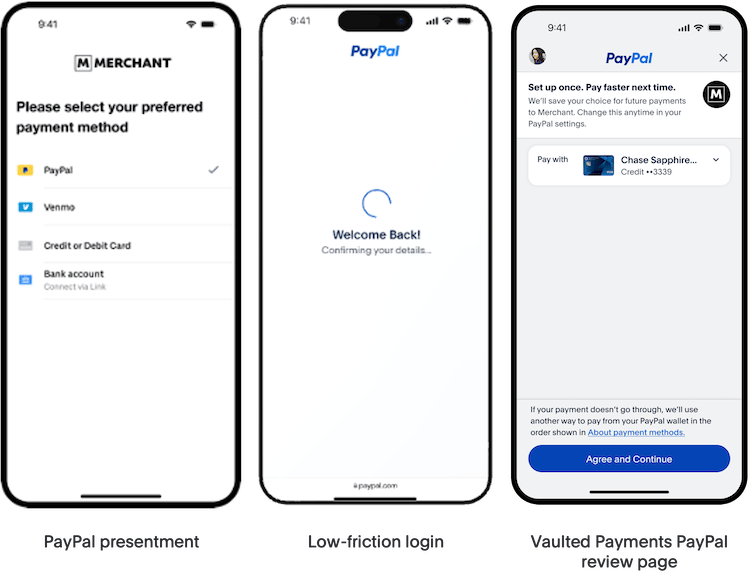
By vaulting a customer's payment details (for the merchants) at first checkout, PayPal eliminates re-entry on every subsequent purchase — a proven friction reducer. It's reported a 2× higher checkout conversion rate versus guest checkout, and the Baymard Institute found that 27% of US shoppers abandon carts specifically because checkout is too long or complicated. Remembered payment details directly address that drop-off.
05 Design Process
The design process wasn't just visual — it was fundamentally about information architecture. Before a single screen was drawn, the work was to understand what a "customer" meant to a PayPal merchant and how that meaning shifted across merchant types, transaction volumes, and use cases.
06 A unified customer list
The customer list view was designed as a scannable, actionable hub. Vault status is surfaced inline so merchants could immediately identify their highest-value repeat buyers. Delivery address is a first-class column alongside email and last transaction date. The data is synced across PayPal, Braintree and Hyperwallet.

| Customer Name | Delivery Address | Email Address | Last Transaction |
|---|---|---|---|
Sarah Okonkwo |
240 Market St Ste 800, San Francisco, CA 94105 | s.okonkwo@acmecorp.com | $2,400.00 USD on 6/9/23 |
Marcus Delacroix |
Not Provided | marcus@delacroix.io | $480.00 USD on 6/7/23 |
Priya Ramanathan |
55 9th St Apt 511, San Francisco, CA 94103 | pramanathan@techflow.com | $28.56 USD on 5/18/24 |
Jordan Wu |
180 Sansome St, San Francisco, CA 94104 | jordan.wu@studio.co | $1,160.00 USD on 6/10/23 |
Elena Vasquez |
1 Market St, San Francisco, CA 94105 | evasquez@globalretail.net | $22,500.00 USD on 6/11/23 |
07 Customer Detail
The customer detail view was designed around progressive disclosure. Every merchant sees the same core profile. But the right column adapts based on source: Braintree merchants see vault tokens and risk data; Hyperwallet platforms see compliance status and payout methods.
08 Field Taxonomy
One of the most consequential design decisions was determining which fields to show, when, and for whom. I developed a four-tier field classification that became the foundation for both the UI and the API design.
09 Persona & Segmentations
The Customers feature had to work for a Shopify-adjacent SMB processing $2K/month and a Fortune 500 enterprise processing $2B/year — without building two products. The strategy: a single adaptive interface where complexity emerges only when needed.
Simple. Fast. Clear.
A lightweight CRM — find who bought what, send a follow-up invoice, see whether a card is still valid. Vault status is a clear benefit badge.
- · Minimal fields shown by default
- · Vault explained in plain language
- · No API terminology in the UI
- · One-click actions (charge, email, refund)
Segments. History. Insight.
Segment customers by vault status, filter by spend band, understand churn signals. Capabilities unlock naturally as customer count grows.
- · Advanced filters (vault, source, spend)
- · Bulk operations (charge, export)
- · Customer segments
- · Transaction trend indicators
API-parity. Control. Compliance.
Every field accessible in the API is visible in the dashboard. Compliance data, audit trails, and custom field support — without breaking the experience for other tiers.
- · Custom fields (Braintree key/value)
- · Compliance & risk data visible
- · Hyperwallet payout fields surfaced
- · Audit log & data export (GDPR-ready)
10 Reflection
Working on Customers at PayPal was a lesson in the difference between a feature and a foundation. The customer profile isn't useful in isolation — it's the connective tissue that makes every other payment product smarter. A transaction gains meaning when you know who made it. A vault token becomes a relationship when it's tied to a name, a history, a context.
The design challenge of integrating Braintree and Hyperwallet wasn't primarily technical — it was conceptual. I had to develop a vocabulary that worked across three very different customer models and make it feel natural to merchants who didn't know or care about the underlying acquisitions.
"The vault wasn't a new technology — it had existed in Braintree for years. The design insight was that surfacing it as a first-class concept in the merchant dashboard transformed it from a developer tool into a growth lever every merchant could understand and act on."